Automated legislative monitoring for a business-first law firm.
How we built LexAlert for S&K (The Legal Team That Speaks Business): an alerting system that polls the PGD Lisboa database every three hours, filters by practice area, and tells the team only when something worth opening has landed.
IndustryLegal
TimelineOngoing
TypeAutomated monitoring system
RegionPortugal
Every 3hPolling cadence against PGD Lisboa
24/7Coverage incl. nights, weekends, holidays
5Practice areas monitored
Context
A business-first law firm.
S&K is a Portuguese law firm built around the corporate world, with practice areas covering commercial, labour, tax, and data-protection law. Their positioning is in the name: The Legal Team That Speaks Business. They are hired by clients who expect their lawyers to understand the commercial reality of the decisions in front of them - and to anticipate the regulatory ones.
That promise is operationally demanding. Anticipating regulatory change means knowing about it before the client does. In a country where new decrees can land on a Friday night and apply on the following Monday, the gap between “published” and “noticed” was the load-bearing piece of work that hadn’t been systematised yet.
Problem
Reactive monitoring, uneven coverage, senior time spent triaging noise.
Legislative monitoring at S&K was an informal, individually-owned task. Each lawyer scanned the Diário da República and the consolidated-law databases for the areas they led, on a cadence that depended on workload. The result was patchy: critical changes were sometimes caught immediately, sometimes flagged days late, and sometimes by the client.
The deeper cost wasn’t the missed change - it was the time senior lawyers spent triaging legislation that turned out to be irrelevant. A new portaria takes the same five minutes to evaluate whether it’s noise or signal; multiply by every entry, every week, across every practice area, and the firm was losing days of high-rate time to filtering work no client was paying for.
Manual, reactive monitoring
Tracking legislative change depended on sporadic checks of the Diário da República and legal databases like PGD Lisboa. With no systematic process, a relevant change could be missed until it was already too late.
Senior time spent triaging noise
The legal team spent hours each week scanning recent legislation, most of which wasn’t relevant to their clients. Senior lawyers were filtering instead of analysing impact.
Reactive instead of proactive
S&K’s clients expect the firm to flag legislative change before they’re surprised by it. Without an alerting system, the firm was reacting to changes instead of anticipating them, the opposite of what their positioning promises.
Uneven coverage across practice areas
Each lawyer informally monitored their own area, but there was no guarantee of complete coverage. A labour-law change might be caught; a tax decree relevant to the same client could slip through.
Approach
Push by email, stay silent by default, and calibrate until lawyers trust the alerts.
Lawyers don’t need another platform to log into. They need information to arrive where they already work, their inbox, in a shape they can act on without reformatting. The first architectural decision was that LexAlert is push-only: it never asks the team to come and check it.
The second decision was the harder one: silence is the default state. A system that fires too often gets muted in week two and ignored in week three, and the firm is back to manual monitoring with an extra subscription line on the invoice. LexAlert is calibrated against S&K’s actual practice areas and tested on real legislation before it goes live, so every alert the team receives is worth opening. The system’s job is to decide what to skip; the lawyer’s job is to read what arrives.
Build
A scheduled, calibrated, deduplicated alerting pipeline.
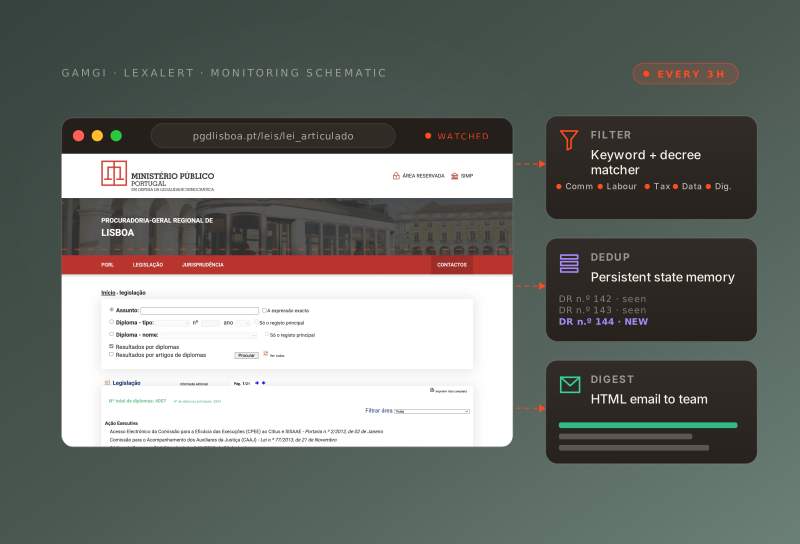
LexAlert runs as a continuously-scheduled pipeline against the PGD Lisboa consolidated-law database. Every three hours it pulls the latest entries, runs them through a filter matrix calibrated to S&K’s practice areas, separates critical-decree amendments from broader keyword matches, deduplicates against everything it has ever sent, and dispatches a single formatted email digest to the team.
Continuous legislative polling: every three hours, the system queries the PGD Lisboa database, the most complete and up-to-date Portuguese consolidated-law reference.
Practice-area keyword filtering: each new entry is compared against a keyword + decree set configured for S&K’s areas: commercial, labour, tax, data protection, and digital.
Critical-decree change detection: diplomas like the Código do Trabalho, the Código Civil, the Lei de Proteção de Dados, and the Código das Sociedades Comerciais are tracked explicitly. Any amendment triggers an immediate, highlighted alert.
Priority-organised email digests: the team receives a single formatted email per cycle. Critical-decree changes lead; keyword matches follow. No noise, no irrelevant entries.
Deduplication memory: the system remembers what it has already flagged. The same legislative entry never appears in a second alert.
Deduplication is the piece that quietly earns trust. The system holds persistent memory of every entry it has ever flagged, so the same decree never appears in a second digest. Combined with the silence-by-default calibration, this means every email LexAlert sends is new information, which is the only thing that keeps a lawyer reading past week three.
Web scrapingScheduled jobsKeyword + decree filter matrixPersistent dedup stateEmail delivery
Result
From individual vigilance to a process the firm can audit.
From reactive to proactive
S&K is now the first point of contact when relevant legislative change lands. Instead of waiting for a client to ask “did you see this new law?”, the firm gets there first, reinforcing the value clients expect from a trusted legal partner.
Hours recovered every week
The time the team used to spend manually triaging legislation has been all but eliminated. Lawyers now receive only filtered, relevant entries, freeing time for impact analysis, the work that actually generates value.
Complete, consistent coverage
Every practice area is watched with the same rigour, 24 hours a day, 7 days a week. A decree published on a Friday night is caught and flagged before the team arrives on Monday.
Competitive differentiation
In a market where most firms still rely on manual checks or generic alerting services, LexAlert positions S&K as a technologically advanced, client-oriented practice.
A promise made auditable
“The Legal Team That Speaks Business” implies anticipating regulatory risk. LexAlert turns that promise into a concrete, repeatable process, one with a paper trail every time an alert fires.
Calibrated, not generic
The filter rules were tuned together with S&K’s lawyers on real legislation, so the system catches genuine signal without flooding inboxes. When an alert arrives, the team knows it’s worth opening.
“In a profession where staying current isn’t optional, LexAlert changed the way we work. Legislative monitoring used to be a thankless task, necessary but time-consuming. Now the relevant information arrives filtered and prioritised. The most important part: our clients feel the difference. When we call to warn them about a legislative change before they read about it in the paper, we reinforce exactly what sets us apart: we’re the legal team that anticipates, not the one that reacts.”
Whether you’re exploring AI or ready to implement, start with an AI audit.
We’ll use the session to understand your workflows, identify or validate the best use case, and map the right path to implementation. You leave with clear next steps, whether you work with us or not.