ContextAn established education institution.
The client is an established education institution covering the full early-years to second-cycle span: crèche, preschool, and the first two cycles of basic education. Day-to-day, a small administrative team is responsible for keeping hundreds of families informed across dozens of class groups.
The communication reality matched the families’ reality: WhatsApp is the default channel parents already use, often with children enrolled in two or more classes at once. Until WA Center, every message was sent by hand: one parent, one class, one staff member at a time.
ProblemManual communication that couldn’t scale.
As enrolment grew, the manual process became a daily bottleneck for the administrative team. Sending individual WhatsApp messages, tracking delivery by hand, and maintaining contact lists in spreadsheets meant every routine update consumed hours that should have gone to higher-value work.
They needed a system that could handle broadcast messaging to entire class groups, track delivery in real time, and give coordinators autonomy without depending on a single administrator. Off-the-shelf tools were either too generic, too expensive, or didn’t integrate with WhatsApp - the channel parents already used.
Time-consuming manual process
Staff spent hours each week sending individual messages to parents across multiple class groups.
No delivery tracking
No way to know which parents received, read, or missed critical school communications.
Fragmented contact data
Parent contacts scattered across spreadsheets with no central, structured database.
Limited staff autonomy
Only one person could send messages, creating dependency and delays.
Built around how the school actually operates.
We designed and built WA Center from the ground up, a full-stack web platform tailored to the institution’s exact workflows. Rather than adapting a generic tool, we created a system that mirrors how the school actually operates: organised by classes, school years, and the relationships between parents and students. The architecture assumes WhatsApp as the messaging substrate, not as a plug-in.
The decision to build rather than license came from the audit: every off-the-shelf option either forced a workflow that didn’t match the school’s, billed per-message at a cost that didn’t scale, or treated WhatsApp as a secondary channel. Building was the cheaper, more flexible, and more sovereign path: the client owns the platform and the data.
BuildA purpose-built communication platform.
Four functional surfaces ship inside WA Center, each addressing one of the friction points the audit surfaced: broadcasting, contact management, role-scoped access, and reliable scheduling.
Intelligent broadcast system
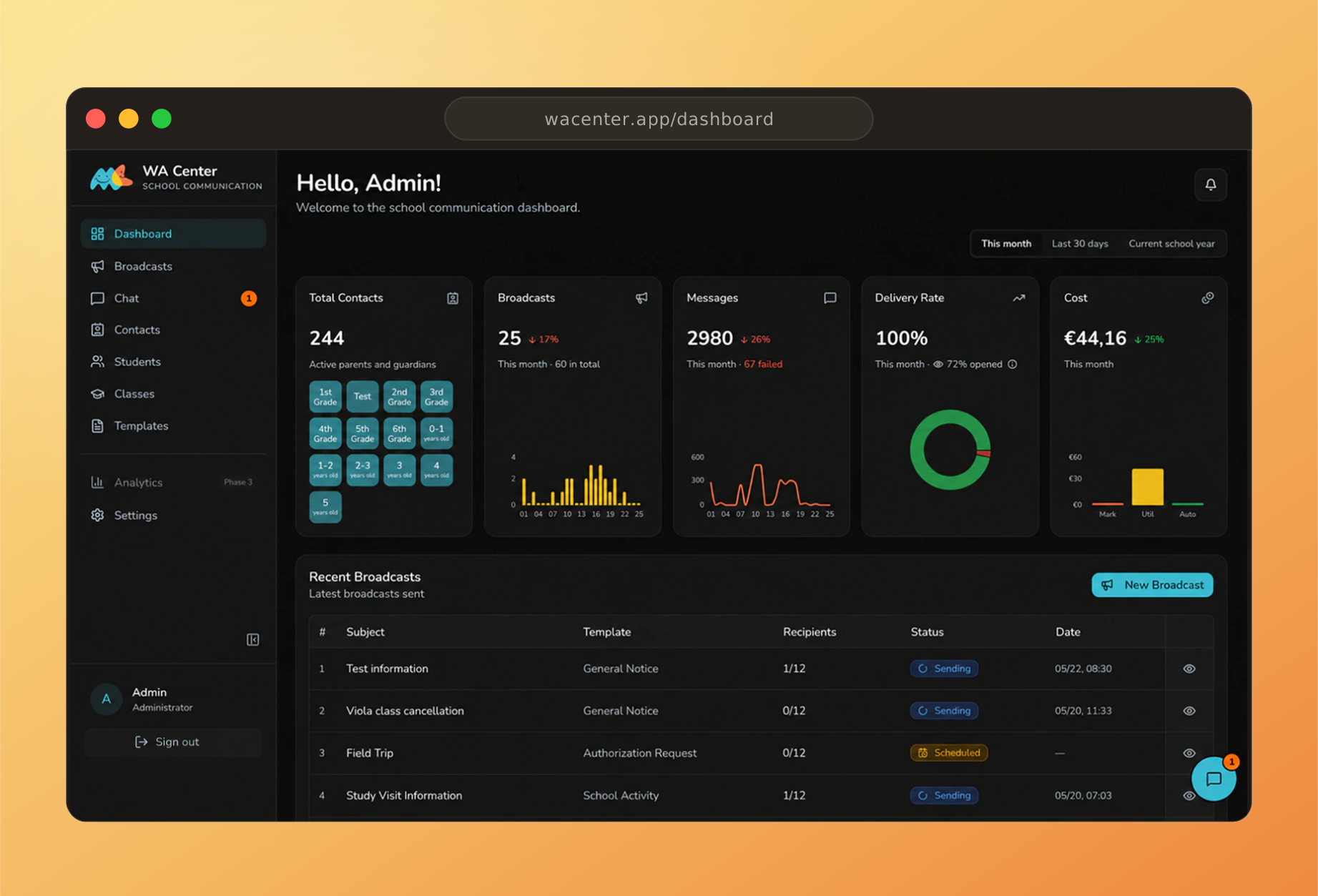
Staff compose messages using pre-approved WhatsApp templates, select target class groups, and send - or schedule for later. The platform handles recipient deduplication automatically, tracks delivery status in real time, and provides cost estimates before sending.
Structured contact management
A centralised database replaces scattered spreadsheets. Contacts can be managed individually or imported in bulk via CSV. Each contact is linked to specific classes and students with proper relationship tracking. Phone numbers are validated and formatted for over 270 countries.
Role-based access
Three permission levels - administrator, coordinator, and viewer - give the right people the right level of control. Coordinators can independently send messages to their assigned classes without needing administrator involvement.
Scheduling & automation
A fail-safe broadcast scheduling system lets staff compose messages in advance and set them to send automatically. The architecture includes redundancy mechanisms that guarantee delivery even through server restarts.
Under the hood, the platform is engineered for the kind of reliability a school’s daily comms cycle demands: messages don’t fail silently, scheduled broadcasts survive server restarts, and permissions hold under load.
- 14+ interconnected data models covering users, contacts, students, classes, templates, broadcasts, and message tracking
- Real-time message queue with automatic rate limiting, retry logic, and fault tolerance
- WhatsApp Business API integration with webhook-based delivery tracking and cryptographic security
- Role-based authentication with JWT sessions, rate-limited login, and secure password management
- Responsive interface across desktop, tablet, and mobile - with light and dark mode
- Broadcast scheduling engine with database-backed reliability and automatic safety-net mechanisms
- Bulk data import with intelligent validation, duplicate detection, and multi-format support
Next.jsReactTypeScriptPostgreSQLRedisWhatsApp Cloud APITailwind CSS
ResultFrom hours of manual work to one-click communication.
Drastic time savings
What previously required hours of individual messaging now takes minutes through targeted class broadcasts.
Full delivery visibility
Real-time tracking of every message - sent, delivered, read, or failed - with per-recipient reporting.
Team empowerment
Multiple staff members can now communicate independently within their areas of responsibility.
Data integrity
A single source of truth for parent contacts, class assignments, and communication history.
Channel alignment
Communication happens on WhatsApp, the channel parents already use daily, with no app downloads needed.
Fully localised
Every interface element in the client’s local language, respecting local conventions and terminology.
A platform that grows with the institution.
WA Center is designed for continuous evolution. Upcoming phases include two-way chat capabilities within WhatsApp’s messaging window, detailed communication analytics, student-centred data management with birthday tracking, and expanded administrative tools. The architecture accommodates these additions without disrupting existing workflows.
This is how we work at gamgi: we don’t deliver a product and walk away. We build systems that evolve alongside your business, continuously identifying new opportunities to create value.