Generative AI in Operations: What Actually Moves the Needle
Unlock the full potential of generative AI in operations by redesigning processes for significant efficiency gains and measurable success.

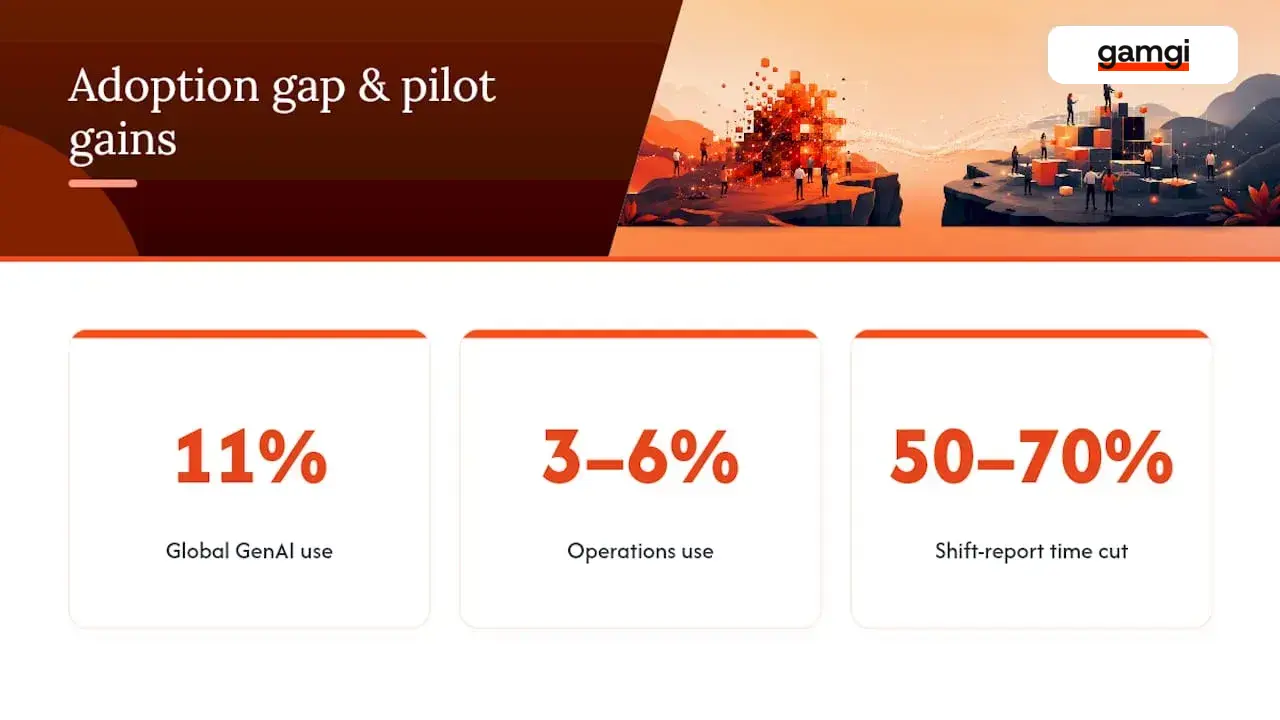
Generative AI in operations delivers real gains only when you redesign the process end to end for agentic execution, not when you bolt a chatbot onto a workflow that was already broken. Right now, only 11% of companies worldwide use GenAI at scale, and in operations specifically that figure drops to 3% to 6%. That gap is the opportunity. A well-scoped quick win, like automating shift reports, has cut delivery time by 50% to 70% in real deployments. The immediate move: pick one bounded process, define success metrics before you touch a model, and run a lighthouse pilot with clear guardrails. Everything else follows from getting that first pilot right.
Key Takeaways
Generative AI in operations creates measurable value only when a process is redesigned end to end for agentic execution and backed by governance built in from the start.
| Point | Details |
|---|---|
| Close the scaling gap | Only 3% to 6% of companies have scaled GenAI in operations, versus 11% globally, so most of the opportunity remains unclaimed. |
| Start with a bounded pilot | Choose one process with an existing baseline metric, clear success gates, and a rollback plan before expanding. |
| Build the control plane early | Managed identities, model access policies, and audit logging need to be designed into the first pilot, not retrofitted later. |
| Fix the confidence gap | Manager playbooks and live coaching close the trust gap between leadership and frontline teams running the new process. |
| Work with a delivery partner that maps first | gamgi audits the operation end to end before building, then ships and owns the roadmap in production. |
Table of Contents
- What Changes When You Put Generative AI Into Operations
- Where Generative AI Delivers the Most Value in Operations
- How to Pick a Lighthouse Pilot That Actually Proves Something
- Designing for Scale: From One Pilot to an Agentic Operation
- The Architecture Behind Reliable Agentic Operations
- Governance and Assured Autonomy for Generative Models
- Preparing Managers and Frontline Teams for the Shift
- How gamgi Approaches Generative AI in Operations Delivery
- An Editorial Take on the Pilot-to-Scale Playbook
- Building Generative AI Systems That Actually Run in Your Operation
- Frequently Asked Questions
- Sources
What Changes When You Put Generative AI Into Operations
Most operations teams start by asking “where can we add a copilot?” That’s the wrong question. A copilot assists a single step, a person drafting an email, a technician looking up a manual. Agentic AI is different: it’s a system that plans, acts, checks its own work, and hands off across multiple steps without a human approving every move. Agentic enterprise operations require redesigning processes end to end for multistep autonomy, not layering intelligence onto a workflow nobody has rethought since 2015.

That distinction changes how you plan a rollout. Layering AI onto an unstable process just makes the instability faster. Outcomes-first redesign means you define the result you want (invoices closed same-day, a maintenance ticket resolved without escalation) and rebuild the steps around achieving that, with AI handling the parts that need judgment across multiple data sources.
Implications for readiness:
- Process maps need to define decision rights, not just task sequences.
- Governance has to evolve alongside autonomy, not get bolted on after deployment.
- Data quality becomes a hard blocker, not a nice-to-have, once an agent acts on it directly.
- Success metrics must be outcome-based (cycle time, error rate) rather than adoption-based (logins, queries answered).
Where Generative AI Delivers the Most Value in Operations
Not every process deserves a pilot. The highest-value targets share one trait: high transaction volume paired with repetitive judgment calls. That combination is where AI in business operations pays for itself fastest.
- Customer service. Gen AI agents handling tier-one inquiries have driven a 30% reduction in call volume and 25%-plus reduction in average handle time in documented deployments. This is usually the fastest lighthouse win because the data (call transcripts, ticket histories) already exists in structured form.
- Supply chain. Demand forecasting and exception handling benefit from agents that can synthesize supplier data, weather, and order history faster than a planner working three spreadsheets at once. This tends to be a longer-term agentic build rather than a week-one pilot.
- Finance and back office. One documented case saw a bank’s credit-risk memo agent increase revenue per relationship manager by 20%, while an FP&A assistant cut operating expenses by $6 million to $10 million at a consumer goods company.
Customer service and shift-report automation are quick wins. Supply chain and full finance-function redesign are agentic plays that take longer but scale further.
How to Pick a Lighthouse Pilot That Actually Proves Something
A pilot that can’t produce a clean before-and-after number is a demo, not a pilot. Selection criteria matter more than enthusiasm here.
- Measurable KPIs exist already. If you can’t state the current handle time, error rate, or cost per transaction today, you can’t prove improvement later.
- Scope is bounded. One process, one team, one clear entry and exit point. Resist the urge to pilot “customer service” instead of “tier-one billing inquiries.”
- Data readiness is confirmed, not assumed. Check that the underlying records are structured enough for a model to act on reliably, before committing a timeline.
- Reusability is designed in. A pilot that only works for one team wastes the investment. Build the pattern so it transfers to a second process later.
A workable pilot checklist covers scope, success gates, a rollback plan, and a compliance sign-off before day one, not after.
Pro Tip: Set your success gate before launch, not at the review meeting. “See how it goes” is not.
Leaders who follow this discipline report payback periods compressing to roughly six to 12 months, largely because they design pilots to be reusable from the start rather than one-off proofs of concept.
Designing for Scale: From One Pilot to an Agentic Operation
A single successful pilot proves the concept. It doesn’t prove you can run twenty agents across five departments without chaos. Scaling generative AI use cases requires a staged pathway, not a leap.
The graduation model that BCG’s research on agentic enterprise operations describes runs in three stages. First, an MVP pilot with a fixed scope and hard success gates. Second, a staged rollout that extends the same agent pattern to adjacent teams or geographies, testing whether the design holds under different data conditions. Third, full end-to-end agentic ownership, where the process runs with multistep autonomy across its entire lifecycle rather than in isolated pieces.
Getting past stage one requires organizational muscle most companies haven’t built yet:
- A centralized capability, sometimes called an “agentic process transformation factory,” that owns redesign methodology across business units instead of leaving each team to reinvent it.
- A named agentic process owner accountable for a given end-to-end outcome, similar to how a product owner works in software, but for an operational process instead of a feature backlog.
- Shared AI services (identity management, model access, monitoring) so every new agent doesn’t require its own bespoke infrastructure.
- A plan for the operational complexity that comes with scale: hundreds of agent identities, config items, and permission sets, all of which need the same audit discipline as employee access controls.
Successful organizations centralize this transformation capability and treat scaling as productization rather than a series of disconnected pilots each fighting for its own budget and infrastructure. Skipping that centralization is the single most common reason a company gets three good pilots and never gets a fourth.
The Architecture Behind Reliable Agentic Operations
IT leaders inherit the hard part: making sure a system that generates probabilistic output behaves predictably in production. That starts with the control plane, the layer that governs which models an agent can call, what data it can touch, and under what identity it acts.
Core architecture components worth getting right from day one:
- Managed identities per agent. Every agent needs its own service identity, the same way a human employee has an account, so its actions are traceable and revocable independent of any other system.
- Model access policies. Define which models handle which tasks, and lock down which agents can escalate to a more capable (and more expensive) model without a human check.
- Observability on drift, latency, and cost. A model that answers correctly in January can drift by June as underlying data shifts. Track it the same way you’d track a KPI dashboard, not as an afterthought audit.
- Audit logging on every decision with consequence. If an agent approves a refund or reroutes a shipment, that action needs a record as complete as if a person had signed off on it.
- Safe fallback paths. Every agentic workflow needs a documented “rescue” flow, a way to hand a stuck or low-confidence case back to a human without breaking the process it sits inside.
Platforms built for operational visibility, like the monitoring and compliance tooling in Curcle’s operations features, illustrate the kind of control-plane thinking IT teams need even when building custom agent infrastructure rather than buying it off the shelf.
Governance and Assured Autonomy for Generative Models
Generative models are stochastic. They don’t always give the same output for the same input, and that’s precisely the property that makes governance non-negotiable in operations rather than optional. Assured-autonomy design pairs stochastic models with formal control logic, robustness testing, and adversarial scenario evaluation to make agentic systems dependable enough to trust with real transactions.
In practice, that means:
- Stress-testing agents against edge cases and adversarial inputs before production, not after an incident.
- Enforcing memory hygiene, so an agent doesn’t carry stale or incorrect context into its next decision.
- Setting explicit permission boundaries and rollback mechanisms for every action an agent can take.
- Capping cost-performance tradeoffs so an agent can’t silently escalate to an expensive model on every call.
- Assigning clear ownership for monitoring signals like decision reversal rates and escalation frequency.
Guidance on disclosure and compliance frameworks, such as the practical breakdowns in AI Act Icon’s governance guides, is worth reviewing alongside internal controls, since regulatory expectations for AI transparency are tightening globally.
Preparing Managers and Frontline Teams for the Shift
The technology rarely kills an AI rollout. The handoff to the people running the redesigned process does. Bain’s research found a significant confidence gap between senior leaders and employees working inside AI-driven redesigns. That confidence gap is where adoption stalls.
Roles shift from doing the task to supervising, designing, and improving the system that does it. That requires:
- Manager playbooks that spell out when to override an agent’s decision and when to trust it.
- Decision-rights matrices so it’s clear who owns an escalation before it happens, not during a crisis.
- Live coaching during the first weeks of a new process, not a one-time training session.
Pro Tip: Invest disproportionately in your middle managers before launch. They translate the redesign into daily routine, and if they don’t trust it, neither will their teams.
How gamgi Approaches Generative AI in Operations Delivery
Most AI efforts stall because building starts before anyone has confirmed which problem is worth solving. gamgi reverses that sequence.
- Map the operation end to end to find where a system creates the most value, including a written recommendation of what not to build.
- Build the pilot with the same team that did the mapping, so context never gets lost in a handoff.
- Ship into production, integrated with the existing stack, typically in weeks rather than quarters.
- Own the roadmap after launch, improving the system as the operation itself changes.
Security, privacy, and compliance get built in from the first line of code: data residency in the regions clients operate, complete audit logging, and human oversight on any decision with real consequence.
gamgi is model-agnostic, works with a perpetual license and source-code escrow so no client is locked in, and has been recognized by Clutch as a Top Generative AI Company for 2026.
An Editorial Take on the Pilot-to-Scale Playbook
The consulting literature on this topic is right about the mechanics and often quiet about the actual bottleneck. Everyone agrees you need a bounded pilot with clean KPIs. Fewer people say out loud that the reason most companies never get past pilot three or four isn’t technical, it’s that nobody owns the redesign discipline centrally. Each team reinvents governance, reinvents the control plane, and burns budget rebuilding the same guardrails five times.

The conventional advice also overweights the technology decision (which model, which vendor) and underweights the confidence gap between leadership and the people actually running the new process. A pilot that hits its KPI on a dashboard but that frontline staff quietly route around is a failed pilot with good metrics.
If you’re prioritizing, do it in this order: pick one process with existing data and a clean baseline metric, build the control plane thinking (identity, permissions, rollback) into that first pilot rather than retrofitting it later, and put a real budget line behind manager coaching before you touch a second use case. Scale is an organizational design problem wearing a technology costume.
Building Generative AI Systems That Actually Run in Your Operation
If the pattern in this article sounds familiar, an audit-first process, a bounded pilot, production deployment with a control plane already designed in, that’s the same sequence gamgi runs on every engagement. The difference from a generic AI vendor is that gamgi starts with a full map of your operation before writing a line of code, so the pilot you get is the one worth building, not the one that happened to be easiest to sell.
That matters most for operations leaders who’ve already watched one AI initiative stall because it automated the wrong step. gamgi’s engagements integrate directly into the systems you already run, with no rip-and-replace and a written recommendation of what not to build alongside what to. Explore gamgi’s capabilities or start with a scoped AI audit to find where your operation has the most value sitting unclaimed.
Frequently Asked Questions
What is the difference between generative AI and agentic AI in operations? Generative AI produces content or drafts, like a copilot writing an email. Agentic AI plans, acts, and checks its own work across multiple steps without approval at every turn, which is why agentic operations require redesigning processes end to end rather than adding a chat interface to an existing workflow.
How long does it take to see ROI from generative AI in operations? Leaders following disciplined pilot design report payback periods of roughly six to 12 months, largely because they build pilots to be reusable across teams rather than as one-off proofs of concept.
Which operations processes benefit most from generative AI first? Customer service and shift-report automation tend to deliver the fastest measurable wins, with documented handle-time reductions above 25%, because the underlying data already exists in structured form.
Why do most generative AI pilots in operations fail to scale? The most common cause is organizational, not technical: no centralized capability owns process redesign, so each team rebuilds governance and control infrastructure independently, and the confidence gap between leadership and frontline staff stalls adoption even when the metrics look good on paper.
Sources
- Assured autonomy: How operations research powers and orchestrates generative AI systems | NSF Public Access Repository
- Generative AI will first be successfully scaled in business operations | McKinsey operations blog