AI for Field Service: The CTO's Implementation Playbook
Unlock the potential of AI for field service. Learn to identify pilot opportunities that boost efficiency and ROI in no time!

Yes, AI can and should automate field service operations - and the highest-impact first move is a focused AI audit to identify your top three pilot opportunities. Over 75% of mobile workers report that AI saves them time on daily field operations. This level signals a shift from optional to expected. The organizations pulling ahead aren’t waiting for a perfect data strategy; they’re running tight pilots on admin automation and knowledge capture, proving ROI in weeks, then scaling.
What to do right now:
- Commission a 2-4 week AI audit (gamgi’s audit methodology scores opportunities by impact, feasibility, and data readiness)
- Identify 1-2 high-frequency, low-risk pilots: automated work-order creation or technician knowledge search
- Set outcome-based KPIs before the pilot starts - first-time fix rate, mean time to repair, invoice-cycle time
The TSIA’s 2026 field service analysis frames this as a structural shift: AI is moving field service from reactive, utilization-based billing toward outcome-based, value-selling models. That’s not a technology upgrade. It’s a business model change.
Table of Contents
- Why invest in AI for field service now?
- Which AI use cases deliver the fastest ROI in field service?
- What data and systems do you need before starting a pilot?
- What does a realistic implementation roadmap look like?
- How do you measure success and model ROI?
- What security and compliance issues matter in U.S. field operations?
- How do you choose the right AI vendor for field service?
- What do real field service AI deployments look like?
- Key Takeaways
- The gap between AI hype and what actually moves the needle in field service
- gamgi’s audit-to-pilot service for field operations
- Useful sources and further reading
Why invest in AI for field service now?
Three forces are converging. Labor markets for skilled technicians remain tight, customer uptime expectations have risen sharply, and the economics of outcome-based contracts now favor organizations that can predict and prevent failures rather than just respond to them.
TSIA’s analysis describes this as AI decoupling service value from human labor hours - you sell uptime and reliability, not billable visits. That’s a fundamentally different P&L. Automating admin tasks (work-order creation, parts requests, status updates) frees technicians for diagnostic and relationship work that actually drives contract renewals.
The talent angle is equally pressing. AI can roughly halve time-to-proficiency by capturing senior technicians’ expertise and surfacing it to junior staff in real time. When your best people retire, that knowledge doesn’t walk out the door.
Which AI use cases deliver the fastest ROI in field service?
Not all use cases are equal. Start with high-frequency, low-risk automation, then advance to predictive and agentic capabilities once your data infrastructure is proven.
Tier 1 - Start here (fastest time to value):
- Automated work-order creation and admin: AI drafts work orders from email or voice, updates status fields, and triggers parts requests. PTC’s field service research confirms this frees staff from repetitive, rule-based tasks immediately.
- Knowledge capture and search: Index manuals, technician notes, and repair photos into a searchable hub. New hires get expert-level answers on day one.
- Intelligent self-service: Agentic AI handles routine client questions and remote diagnostics before a truck rolls. TSIA projects this will resolve a significant share of routine queries without human intervention.
Tier 2 - Scale after Tier 1 proves out:
- Predictive maintenance: IoT sensor data feeds ML models that flag failures before they occur. Vendor case data suggests that AI pre-diagnosis can substantially reduce truck rolls in wind-power applications.
- Automated scheduling and route optimization: AI optimizes dispatch by matching technician skills, location, and parts availability simultaneously, cutting travel time per job.
- Parts and inventory forecasting: ML models predict demand and reduce emergency orders, directly improving first-time fix rates.
Tier 3 - High maturity, high reward:
- Agentic end-to-end orchestration: AI agents coordinate work orders, parts procurement, and technician scheduling in a closed loop, improving MTTR and enabling continuous learning across the fleet.
What data and systems do you need before starting a pilot?
| Data Source | Why It’s Required | Integration Type |
|---|---|---|
| FSM / CRM / ERP | Work orders, customer history, SLA terms | API or webhook |
| IoT / telemetry feeds | Equipment sensor data for predictive models | Real-time stream |
| Parts / inventory system | Stock levels, lead times, supplier data | Batch or API |
| Past service tickets | Training data for diagnostic AI | Bulk export |
| Manuals and diagrams | Knowledge base for remote assist and search | Document ingestion |
| Mobile device logs | Technician activity, location, and time-on-task | Mobile SDK or MDM |
| Identity and roles | Access control, audit trail | SSO / directory sync |
Before any model training begins, audit your data quality. Incomplete service tickets and inconsistent part numbers are the most common reasons pilots stall. Also confirm API availability in your FSM and ERP - batch feeds work for some use cases, but predictive maintenance requires near-real-time telemetry.
Pro Tip: Codify tribal knowledge before you build anything. Capture technician notes, annotated photos, and repair walkthroughs into a structured knowledge hub first. AI trained on unstructured tribal memory produces unreliable outputs; AI trained on a clean, indexed knowledge base produces answers technicians actually trust.
For teams navigating custom AI mobile app integration, latency and offline capability are the two issues that kill adoption fastest - plan for both in your architecture review.
What does a realistic implementation roadmap look like?
Phase 1: AI audit (weeks 1-4) Deliverables: opportunity scoring matrix, data readiness report, prioritized pilot brief with success metrics. This is where gamgi’s audit methodology identifies the highest-ROI use cases before any code is written.

Phase 2: Scoped pilot (weeks 5-10) Deliverables: working prototype integrated into one live workflow, baseline KPI measurement, user feedback log. For tightly scoped problems - automated work-order creation, for example - functional systems can be deployed within six weeks.
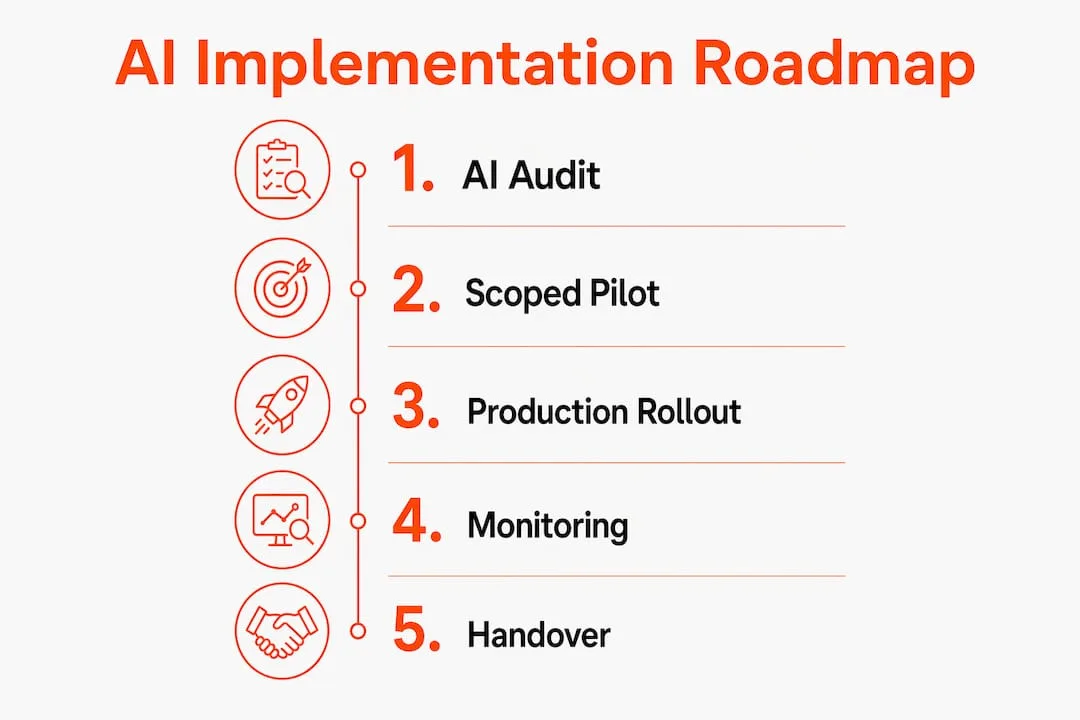
Phase 3: Production rollout (weeks 11-26, scope-dependent) Deliverables: full integration, monitoring dashboard, handover documentation, ops team training. Sprint cadence: 2-week sprints with a defined gate review at each sprint boundary. Gate criteria: KPI movement vs. baseline, error rate below threshold, user adoption above target.
The six-week functional pilot claim holds when the scope is narrow and data is ready. Predictive maintenance across a heterogeneous asset fleet takes longer - plan 12-16 weeks for production.
How do you measure success and model ROI?
Primary KPIs to track from day one of a pilot:
- First-time fix rate - the single best proxy for technician effectiveness and parts readiness
- Mean time to repair (MTTR) - measures diagnostic speed and knowledge quality
- Travel time per job - reflects scheduling and routing efficiency
- Truck rolls per fault - drops sharply when remote diagnostics and self-service work
- Invoice-cycle time - shortens when admin automation removes manual data entry
- Time-to-proficiency for new hires - a direct ROI signal from knowledge-capture investments
A simple ROI model: annualize the labor hours saved per technician (from the Salesforce time-savings finding), add avoided truck-roll costs and downtime reduction, then subtract pilot and integration costs. Even conservative assumptions on a 20-person field team typically produce a payback period under 12 months.
One critical adjustment: as AI removes low-value tasks, raw utilization rates may fall even as actual value rises. TSIA’s deep knowledge on KPI redefinition makes this point explicitly - adjust your management metrics before deployment, or you’ll penalize the teams delivering the best outcomes.
Use an A/B rollout where possible: run the AI-assisted workflow on one team while a control group operates normally. That isolates AI impact from seasonal or market variation.
What security and compliance issues matter in U.S. field operations?
Field AI introduces specific risks: mobile devices accessing sensitive customer data, AI decisions that affect safety-critical equipment, and telemetry feeds that may carry regulated data in utilities or healthcare.
A practical security checklist for pilots:
- Encrypt data in transit (TLS 1.2+) and at rest on all mobile devices
- Implement role-based access control tied to your identity provider via SSO
- Maintain full audit logs for AI-generated recommendations, especially in regulated sectors
- Define a rollback plan: if the AI model degrades, how does the team revert to manual workflows?
- For utilities and healthcare, document how AI decisions are explainable and traceable to comply with sector-specific oversight requirements
- Confirm your AI vendor’s data residency policy - U.S. field data should stay in U.S.-based infrastructure unless contractually specified otherwise
SOC 2 Type II compliance from your AI vendor is a baseline expectation, not a differentiator. Ask for the report, not just the badge.
How do you choose the right AI vendor for field service?
Evaluate vendors across six axes: domain experience in field operations, integration depth with your FSM/ERP stack, data governance and model versioning practices, explainability of AI outputs, deployment speed, and SLA commitments for uptime and support.
Questions to ask in vendor interviews:
- How do you handle data onboarding from legacy FSM systems with inconsistent schemas?
- What’s your model validation process, and how do you detect drift in production?
- Can you explain why the AI made a specific scheduling or diagnostic recommendation?
- What’s your rollback procedure if a model update degrades performance?
- Who owns the model and training data after the engagement ends?
gamgi approaches every field service engagement with an AI audit first - not a demo. The audit scores opportunities by impact, data readiness, and integration complexity, so the pilot brief is grounded in your actual constraints, not a generic use-case template. Functional pilots deploy within six weeks for tightly scoped problems. gamgi is recognized by Clutch as a Top Generative AI Company (New York & Portugal, 2026).
Avoid vendors who skip straight to a solution pitch. The audit-first approach is what separates a pilot that proves ROI from one that proves nothing.
What do real field service AI deployments look like?
Biscoito.ai (gamgi): gamgi built an industry-specific AI assistant for Biscoito.ai, delivering custom conversational and workflow automation aligned to the client’s operational constraints and brand voice. The engagement followed gamgi’s audit-to-pilot methodology, with the solution integrated into existing workflows rather than bolted on as a standalone tool.
Wind-power maintenance (industry example): Vendor case data from the field service AI space cites 50% reductions in truck rolls when AI pre-diagnosis and knowledge capture are deployed together in wind-turbine maintenance. The mechanism is that AI identifies the likely fault remotely, dispatches the right technician with the right parts, and eliminates the diagnostic visit entirely.
Both examples share a pattern: the AI intervention is narrow, the data inputs are well-defined, and the outcome metric is agreed before deployment. That’s the template.
Key Takeaways
Custom AI integration delivers measurable ROI in field service when pilots are scoped tightly, data is prepared in advance, and success metrics shift from utilization to outcomes like first-time fix rate and MTTR.
| Point | Details |
|---|---|
| Start with an AI audit | Score opportunities by impact and data readiness before committing to a pilot. |
| Prioritize admin automation first | Work-order creation and knowledge search deliver fast ROI with low integration risk. |
| Prepare your data before training | Clean service tickets, indexed manuals, and real-time telemetry feeds are prerequisites, not afterthoughts. |
| Redefine KPIs before launch | Measure first-time fix rate, MTTR, and invoice-cycle time - not raw utilization. |
| gamgi as implementation partner | gamgi’s audit-to-pilot model delivers functional field service AI systems within six weeks for tightly scoped problems. |
The gap between AI hype and what actually moves the needle in field service
Most field service AI conversations get stuck on the flashy end: autonomous agents, AR-guided repairs, digital twins. Those are real, and they matter at scale. But the organizations that consistently see ROI start somewhere unglamorous: they fix their knowledge problem first.
The single most underestimated issue in field service AI is not the model - it’s the data. Specifically, the expertise that lives only in the heads of your most experienced technicians. No scheduling algorithm or predictive model performs well when the underlying service data is incomplete, inconsistent, or locked in tribal memory. The teams that invest two weeks codifying that knowledge before training anything else end up with AI that field technicians actually use, rather than AI that gets quietly ignored after the pilot ends.
The second pitfall is KPI mismatch. If your operations team is still measured on utilization and billable hours, they will resist AI that reduces truck rolls - even when that reduction is exactly what your customers want. Align incentives before you deploy, not after.
The practical tip: run your first pilot on a workflow where the outcome is unambiguous and the data already exists. Automated work-order creation from email is boring. It also works on week one, builds trust, and funds the next pilot.
gamgi’s audit-to-pilot service for field operations
Field service AI fails most often not because the technology is wrong, but because the scope is too broad and the data isn’t ready. gamgi’s approach inverts the typical agency model: the engagement starts with a structured AI audit that scores your highest-ROI opportunities before a single line of code is written. From there, gamgi designs and builds custom AI systems that integrate directly into your existing FSM, CRM, and ERP workflows - no rip-and-replace, no months-long IT projects.
For tightly scoped pilots, functional systems go live within six weeks. gamgi is recognized by Clutch as a Top Generative AI Company (New York & Portugal, 2026), and the Biscoito.ai case study demonstrates the audit-to-deployment methodology in practice. If you’re ready to identify where AI will move the needle fastest in your field operations, book an AI audit with gamgi and leave with a prioritized pilot brief, not a generic roadmap.
Useful sources and further reading
- TSIA: The State of Field Services 2026 - analyst perspective on AI Economics™, outcome-based models, and the shift away from utilization metrics
- Salesforce: AI in Field Service Management Guide - practical overview of time-savings data and admin automation use cases
- PTC: AI in Field Service Management - technical breakdown of scheduling, routing, predictive maintenance, and inventory planning capabilities
- Microsoft: How AI can give field service technicians a boost - practical examples of AI-assisted dispatch, remote assist, and knowledge base applications
- gamgi case studies - real deployment outcomes and methodology from gamgi client engagements
- Custom AI predictive maintenance - gamgi’s analysis of when custom predictive maintenance is cost-effective vs. off-the-shelf