IT Helpdesk AI: A CTO's Guide to Governed Autonomy
Discover how IT Helpdesk AI can scale support seamlessly with custom integrations and governed autonomy. Transform your IT operations today!

A bespoke, governed IT helpdesk AI project, integrated with your identity provider, ticketing system, and CMDB, is the fastest path to scaling support without proportionally scaling headcount. Off-the-shelf chatbots handle surface-level deflection. A properly engineered system executes multi-step remediation autonomously, from password resets to Tier 2 diagnostics, while generating the immutable audit logs SOC 2 and ISO 27001 require. gamgi builds exactly this: custom AI systems designed around your operation, not around a vendor’s product roadmap. The immediate next step is to book a discovery audit so you know which workflows to automate first and what integration work is actually required.
- Bespoke integration (identity, ticketing, CMDB) is what separates a working system from a chatbot that deflects easy questions.
- Governance is not optional: audit trails, approval thresholds, and human-in-the-loop escalation are prerequisites for safe autonomy.
- Pilot scope and timeline matter: well-scoped pilots show measurable value within weeks to months.
Table of Contents
- What does an IT helpdesk AI project actually look like?
- How do you choose the right implementation partner?
- What security and governance controls does your AI agent need?
- What KPIs and ROI should you expect?
- What does real-world evidence look like?
- How do you start an audit and pilot today?
- What training and support should you plan for post-launch?
- What risks are specific to AI-driven helpdesks?
- How do you manage organizational change when deploying AI support?
- What does customizing an AI model for your enterprise actually require?
- Key Takeaways
- The case for doing this right, not fast
- What gamgi builds for IT operations teams
- Useful sources
What does an IT helpdesk AI project actually look like?
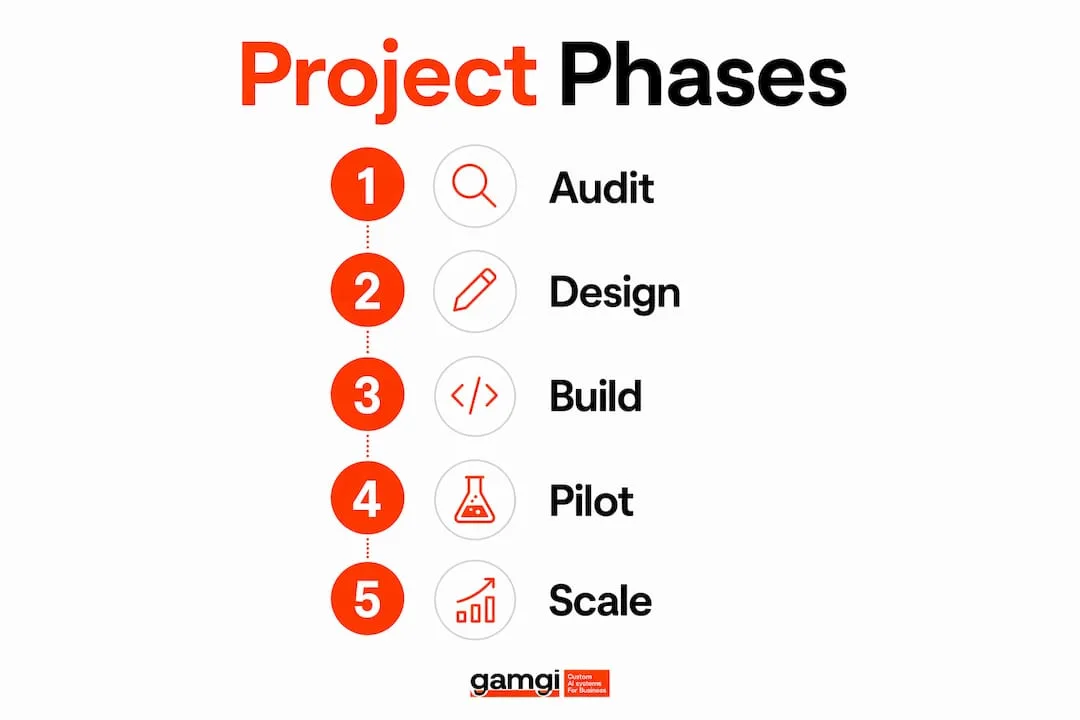
A professional implementation is a project-based engagement with five distinct phases, each with concrete deliverables. Buying a SaaS chatbot skips all of them, which is why most SaaS chatbot deployments stall.
| Phase | Deliverables | Typical Duration |
|---|---|---|
| Audit / Discovery | Workflow maps, ticket taxonomy, integration inventory, risk register | 2-4 weeks |
| Integration & Hardening | API adapters (ticketing, identity, CMDB), policy rules, test plans | 4 weeks |
| Pilot (MVP) | Scoped agent handling 3-5 ticket types, verification scripts, monitoring dashboard | 4-6 weeks |
| Staged Roll-out | Expanded ticket coverage, approval gates, SLA definitions | 4 weeks |
| Continuous Optimization | Live metrics review, model tuning, roadmap updates | Ongoing |
The audit phase is where most projects either succeed or fail before they start. A clean CMDB and documented runbooks are prerequisites; chaotic or undocumented infrastructure stalls agentic AI before it executes a single remediation. The engineering team maps operational workflows to executable playbooks during discovery, so the pilot is built on real data, not assumptions.
Ownership model matters as much as timeline. A bespoke build means your team owns the code, the roadmap, and the data. The same engineers who ran discovery build the integration adapters and stay on post-launch. That is structurally different from a vendor-hosted black box where the roadmap is theirs and you pay per resolution.
How do you choose the right implementation partner?
Checklist before you shortlist anyone:
- Integration depth: can they connect natively to your ticketing system (ServiceNow, Jira), identity provider (Okta, Active Directory), CMDB, and monitoring stack?
- Governance proof: do they show you audit trail samples, approval workflow configs, and escalation logic before you sign?
- Code and roadmap ownership: do you own the source code and can you deploy it in your own infrastructure?
- Model-agnostic deployment: are they locked to one LLM, or do they select the best model per use case?
- Post-launch support: is the same engineering team available after go-live, or does it hand off to a generic support tier?
Questions to ask every vendor:
- Walk me through your discovery process. What do you need from us before writing a line of code?
- Which identity providers and ticketing systems have you integrated with in production?
- How does your agent handle a failed remediation? Show me the rollback and escalation path.
- What does an audit log entry look like, and how do we export it for SOC 2 evidence?
- If we want to swap the underlying LLM in 18 months, what does that cost and who does the work?
- What is your SLA for agent downtime, and what are the financial consequences of missing it?
- How do you scope and price model retraining as ticket patterns evolve?
Red flags that should end the conversation:
- No audit trail or vague answers about logging (“it’s all in the dashboard”)
- Per-resolution pricing with no cap, which creates a perverse incentive to avoid deflection
- No on-premises or data-residency option for regulated industries
- Vendor owns the code and the model weights; you get an API key
- SLAs defined in “best effort” language with no remedies
Pricing models range from fixed-scope project fees to time-and-materials engagements. The honest TCO calculation includes project fees, integration labor, model inference costs at scale, and ongoing optimization. Engineering ownership of the roadmap and contractual clarity on data ownership are the two variables that most dramatically affect long-term cost. For a deeper look at the build-vs-buy decision, the hire vs. build-in-house analysis is worth reading before you finalize your vendor list.
What security and governance controls does your AI agent need?
Autonomy only works when it is governed. That is not a philosophy; it is an engineering requirement.

| Framework | Required Control | Evidence Artifact |
|---|---|---|
| SOC 2 Type II | Immutable action logs with timestamps and pre/post state | Log exports, access reports |
| ISO 27001 | Identity verification before privileged actions, least-privilege execution | IAM policy docs, approval records |
| HIPAA (where applicable) | Data residency in US regions, PHI access controls, audit trails | Data flow diagrams, BAA documentation |
The agent must connect directly to your identity provider via API to verify identity before executing privileged actions like password resets or access provisioning. MFA or SSO verification is not optional for these flows. Every action, what was executed, by which agent, at what timestamp, and what changed, must be captured in an immutable log that your compliance team can export on demand.
Pro Tip: Bound the blast radius before you go live. Scope the agent’s permissions to least-privilege execution, require human approval for any remediation that touches production systems or modifies group memberships, and build a verified rollback path for every automated action. This single design decision accelerates stakeholder sign-off more than any other.
What KPIs and ROI should you expect?
The highest-value implementations go beyond Tier 1 deflection. Custom agents can run multi-step Tier 2 diagnostics, check logs, execute scripts, and close incidents autonomously, which is where senior engineer time is actually recovered.
| KPI | Baseline (Pre-AI) | Pilot Target | Scaled Production |
|---|---|---|---|
| Ticket deflection rate | Low baseline | Moderate pilot target | Higher productivity at scale |
| Mean time to resolution (MTTR) | Hours | Reduced times for scoped types | Faster resolution with broader coverage |
| Cost per ticket | Higher costs | Reduced costs measurable | Costs lowered significantly |
| First contact resolution (FCR) | Moderate baseline | Improved resolution rates | Higher resolution efficiency |
| CSAT | Baseline | Improved satisfaction | Further increased satisfaction |
Teams typically see measurable improvements within weeks to months for targeted pilots where ticket types are well scoped. The monitoring strategy should include automated verification after every remediation (did the fix actually work?), a live dashboard for IT leadership, and a structured review cadence where the engineering team adjusts policies based on real outcomes. Metrics ownership post-launch should sit with a named product owner inside IT ops, not with the vendor. For more on structuring feedback loops and monitoring, the approach applies directly to helpdesk deployments.
What does real-world evidence look like?
gamgi built Biscoito.ai as a domain-specific AI assistant that delivers brand-consistent, contextually accurate responses at scale. The system was engineered around the client’s existing workflows and knowledge base, not bolted on top of them. The result: automated handling of high-volume, repetitive interactions with the brand voice intact and a human escalation path that activates only when the AI’s confidence falls below a defined threshold.
Biscoito.ai demonstrates what bespoke engineering produces that off-the-shelf tools cannot: a system that knows the domain, respects the brand, and escalates intelligently rather than failing silently.
gamgi is recognized by Clutch as a Top Generative AI Company (2026). The same engineering team that scopes a project builds it, owns the roadmap with the client, and continues improving the system after launch. There is no handoff to a generic support tier.
How do you start an audit and pilot today?
Pre-engagement checklist:
- Identify stakeholders: IT ops lead, CISO or security lead, CMDB owner, and a business sponsor with budget authority.
- Pull a 90-day ticket sample: volume by category, resolution time, and escalation rate.
- Document your current integrations: which ticketing system, identity provider, and CMDB are in use and whether APIs are accessible.
- Get legal and privacy sign-off on data handling for the AI system before the audit begins.
- Flag any regulated data types (PHI, PII, financial records) that the agent may encounter.
Pilot scope template:
- Success criteria: deflection rate and MTTR targets for the three to five ticket types in scope.
- Integrations in scope: identity provider (read + write), ticketing system (create, update, close), knowledge base (read).
- Risk controls: least-privilege execution, approval gate for any production-system change, rollback script for every automated action.
- Timeline: four to six weeks from integration complete to pilot results reviewed.
- Deliverables: monitoring dashboard, audit log samples, pilot report with go/no-go recommendation for scaled roll-out.
Book a discovery audit with gamgi to get a workflow map, integration inventory, and a prioritized automation roadmap before committing to a full implementation. The audit is the lowest-risk way to validate scope and cost. For practical guidance on starting automation projects aligned to business metrics, that resource covers the pre-engagement groundwork in detail.
What training and support should you plan for post-launch?
Post-launch is where most implementations quietly degrade. The agent’s knowledge base needs regular updates as your environment changes, new ticket types emerge, and policy rules require adjustment. Plan for a structured onboarding program for IT staff covering how to review agent actions, override decisions, and submit feedback that improves future responses. End-user communication matters too: employees need to understand what the agent can resolve, what it will escalate, and how to reach a human when needed. The engineering team should run monthly reviews of agent performance data for at least the first six months, with a defined process for submitting model retraining requests when accuracy drops on a ticket category.
What risks are specific to AI-driven helpdesks?
The three failure modes that actually end projects are: an agent that executes a privileged action on the wrong account due to identity verification gaps, a model that confidently gives wrong remediation steps because the knowledge base is stale, and a compliance audit that finds no evidence trail for automated actions. Mitigate the first with mandatory MFA verification before any write operation. Address the second with a knowledge base review cycle tied to your change management process. Solve the third by treating audit log completeness as a launch-blocking requirement, not a post-launch enhancement. A bounded blast radius design with approval gates for risky remediations materially reduces all three risks and speeds stakeholder sign-off.
How do you manage organizational change when deploying AI support?
The resistance that kills adoption is almost never technical. It comes from IT staff who fear the agent will make their role redundant, and from end users who distrust automated responses on sensitive issues. Address the first by framing the agent as handling the repetitive tail of incidents so senior engineers can focus on work that requires judgment. Address the second by making the escalation path obvious and fast. Involve IT staff in pilot design, let them review agent decisions during the first weeks, and give them a clear channel to flag errors. The AI augments staff framing is accurate and worth communicating explicitly during rollout.
What does customizing an AI model for your enterprise actually require?
Model customization is not fine-tuning a general LLM on your ticket history and calling it done. It requires a structured knowledge base built from your runbooks, resolution notes, and escalation policies. It requires retrieval-augmented generation (RAG) configured against your CMDB and knowledge base so the agent pulls current, accurate context rather than hallucinating from training data. It requires domain-specific intent classification tuned to your ticket taxonomy. And it requires a feedback loop where agent errors are reviewed, labeled, and fed back into the system on a defined cadence. Model-agnostic deployment, choosing the best LLM for each task rather than committing to one provider, gives you the flexibility to swap models as the market evolves without rebuilding the integration layer.
Key Takeaways
A bespoke, governed IT helpdesk AI project, integrating identity, ticketing, and CMDB, delivers measurable deflection and MTTR improvements while generating the audit evidence SOC 2 and ISO 27001 require.
| Point | Details |
|---|---|
| Governance is a launch requirement | Immutable audit logs, approval gates, and MFA verification must be built in before go-live. |
| Pilot scope drives ROI speed | Well-scoped pilots targeting 3-5 ticket types show measurable results within weeks to months. |
| Ownership model affects TCO | Client-owned code and roadmap avoids long-term vendor lock-in and per-resolution pricing traps. |
| Tier 2 automation multiplies value | Moving beyond Tier 1 deflection to multi-step diagnostics is where senior engineer time is recovered. |
| gamgi as next step | Book a discovery audit with gamgi to get a workflow map, integration inventory, and prioritized roadmap before committing to full implementation. |
The case for doing this right, not fast
The pattern I see most often in failed AI helpdesk projects is the same: a team buys a capable tool, skips the discovery phase because it feels slow, and deploys an agent that handles the five easiest ticket types while the real volume sits untouched. Six months later, the project is quietly shelved because the ROI never materialized.
The projects that work share one characteristic: they started with a rigorous audit of what the support operation actually does, not what the team assumes it does. That audit almost always surfaces two or three high-volume, high-cost ticket categories that nobody had prioritized for automation because they seemed complex. They are complex, but they are also the ones where a well-engineered agent delivers the most value.
The governance requirement is not bureaucratic overhead. An agent that can reset passwords and provision access is executing privileged operations on live systems. If that agent acts on a spoofed request or a stale CMDB record, the blast radius is real. Audit trails and approval gates are what let you give the agent real authority without losing sleep over it.
The organizations that get this right treat the AI helpdesk as a product, not a project. They assign an owner, run a continuous feedback loop, and keep the engineering team engaged after launch. That is the model gamgi operates on, and it is the reason the same team that scopes the work is still improving it a year later.
What gamgi builds for IT operations teams
Most AI helpdesk projects fail at the integration layer, not the AI layer. gamgi’s custom AI systems are built integration-first: every deployment starts with a discovery audit that maps your actual workflows, identifies the highest-impact automation candidates, and produces a prioritized roadmap before a line of code is written.
From there, gamgi’s engineering team builds and ships the system integrated with your existing stack, with full audit logging, data residency in your operating region, and model-agnostic deployment so you are never locked to a single LLM provider. No rip-and-replace. No black boxes. The same engineers own the roadmap with you after launch. Book a discovery audit to see exactly where your highest-ROI automation opportunities are and what integration work is required to capture them. You can also review gamgi’s full capabilities and case studies to validate fit before committing.
Useful sources
- gamgi case studies: Real outcomes from gamgi-built AI systems, including Biscoito.ai, for validating engineering capability and customization depth.
- IT Help Desk Agent, ibl.ai: Detailed breakdown of agentic helpdesk architecture, identity integration requirements, and immutable audit logging for compliance evidence.
- Agentic ITSM, Rezolve.ai: Project model overview covering audit-to-optimization phases and ownership model considerations for enterprise buyers.
- AI Service Desk, SolarWinds: Reference for AI-generated runbooks, incident correlation, and ITSM automation patterns in production environments.
- AI Helpdesk for IT Ticket Resolution, Saxon AI: Time-to-value benchmarks for targeted pilots and guidance on scoping ticket types for early-stage deployments.